Friday, August 17, 2018

Civil Affairs Soldiers Enhance Tanzanian Operations to Counter Illicit Trafficking


By Navy Petty Officer 2nd Class Timothy Ahearn, Combined Joint Task Force Horn of Africa

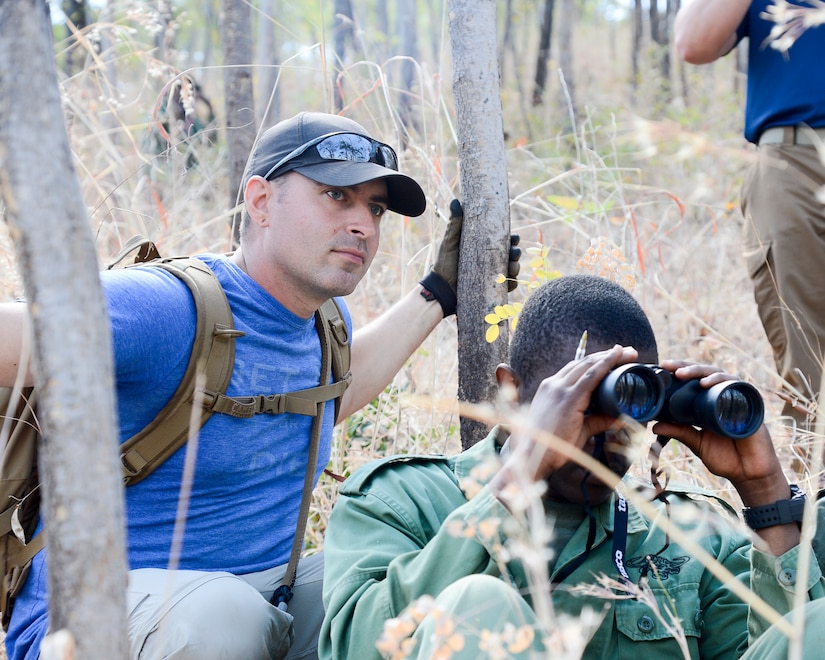
NGWALA, Tanzania -- Deep in one of the largest countries in East Africa, U.S. Army soldiers have been training Tanzanian game wardens in operations to deter poachers and prevent extremist organizations from profiting from illicit activities.

The soldiers, with the 404th Civil Affairs Battalion, attached to Combined Joint Task Force Horn of Africa, conducted training in countering illicit trafficking for Tanzania Wildlife Management Authority game wardens, from May to July.

Tanzania is rich in culture and wildlife such as elephants, giraffes, hippos, and lions. About 38 percent of its land is reserved for conservation.

Illicit trafficking continues to be a transnational problem throughout CJTF-HOA’s area of operations. Enhancing the game wardens’ capabilities will disrupt the flow of illicit trade as well as the funding of violent extremist organizations, Army Maj. Kevin Jusza said.

Poaching Funds Transnational Terrorism

“This illegal poaching and hunting funds transnational criminal activity,” he said. “A lot of these funds have been engaged with transnational terrorist activity. In Kenya, for example, Al Shabab [terrorists] often cross the border from Somalia into Kenya to engage in poaching to fund their operations.”

The training covered a variety of topics such as medical skills, land navigation, ethics and human rights, weapons, patrolling, mission planning, information management and reporting, air to ground reconnaissance, and apprehension. These courses augment the ability to recognize and intercept illicit alleged poachers and illicit traffickers.

As of the end of July, the soldiers had completed three courses and graduated more than 70 game wardens. These wardens use their training daily to accomplish their mission to prevent and deter illicit trafficking and poaching activities. Army Sgt. Matthew Smith said he’s proud to have had such an impact on the Tanzanian game wardens.

“A student we trained last cycle approached me and told me about a mission last month where his team came upon a poaching camp using tactics we taught them to clear and process the site,” Smith said. “I was extremely proud, and for me to be able have a part in their instruction is a huge joy.”

Studies have shown that illegally trafficked goods from Tanzania have been distributed throughout the world. A State Department report from May 2017 said “illicit trafficking remains the lifeblood of the numerous bad actors and networks, creating vulnerabilities for nations.”
U.S. Africa Command assists partner nations in their efforts to provide stability and security to their people. The training provided by the U.S. civil affairs soldiers enables Tanzania to better secure and protect its natural resources and wildlife from transnational threats and extremist organizations, officials said.

Friday, August 3, 2018

New York Man Sentenced to Prison for Trafficking in Endangered Lion and Tiger Parts


Arongkron “Paul” Malasukum, 42, a resident of Woodside, New York, was sentenced today by U.S. District Judge Amos L. Mazzant, III, in Sherman, Texas, to nine months in prison to be followed by one year of supervised release for illegally trafficking parts from endangered African lions and tigers.

Malasukum previously pleaded guilty before U.S. Magistrate Judge Kimberly C. Priest Johnson to a one count information charging him with wildlife trafficking in violation of the Lacey Act.   

In papers filed in federal court, Malasukum admitted to meeting with undercover agents who were working for the U.S. Fish and Wildlife Service, and purchasing a tiger skull from the agents. Malasukum also admitted to purchasing lion skulls from an auction house in Texas through the undercover agents, who were acting as “straw buyers” for Malasukum. Malasukum provided the undercover agents with cash and directed them on which items to bid and ultimately win. After the purchases, Malasukum shipped the tiger and lion skulls from Texas to his home in Woodside, New York. From New York, Malasukum shipped the skulls to Thailand for sale to a wholesale buyer.

As part of his plea, Malasukum admitted that between April 9, 2015 and June 29, 2016, he purchased and exported from the United States to Thailand approximately 68 packages containing skulls, claws, and parts from endangered and protected species, with a total fair market value in excess of $150,000.

The sentence was announced by Acting Assistant Attorney General Jeffrey H. Wood for the Department of Justice’s Environment and Natural Resources Division, U.S. Attorney Joseph D. Brown for the Eastern District of Texas, and Acting Assistant Director of the Office of Law Enforcement for the U.S. Fish and Wildlife Service Edward Grace.

“Today’s sentencing is another positive result from the Justice Department’s continued partnership with the U.S. Fish and Wildlife Service in fighting the menace of illegal trade in protected wildlife,” said Acting Assistant Attorney General Wood. “Those who scheme and plot to criminally profit from the exploitation of these creatures will be brought to justice, as the defendant in this case has now learned”

“The defendant in this case profited from the endangered status of African lions and tigers by illegally buying and selling their parts on the black market,” said U.S. Attorney Joseph D. Brown for the Eastern District of Texas. “We will continue to enforce our endangered species laws to protect our beautiful animal resources.”

“We are committed to bringing to justice those who would profit from the illegal international and interstate trafficking of wildlife,” said Acting Assistant Director of the Office of Law Enforcement for the U.S. Fish and Wildlife Service, Edward Grace. “We thank our state and federal partners for their help in investigating and prosecuting cases on behalf of imperiled species."

There are two sub-species of lions that are listed as threatened and/or endangered under the Endangered Species Act (ESA). Panthera leo melanachaita, found in eastern and southern Africa, is listed as threatened, and Panthera leo leo, found in India and western and central Africa, is listed as endangered. There are only about 1,400 members of the Panthera leo leo species remaining; 900 in 14 African populations and 523 in India. The size and distribution of these populations, population trends, and the severity of the threats to those populations are factors leading to Panthera leo leo being listed as endangered under the ESA. The sub-species Panthera leo melanachaita is believed to number between 17,000 -19,000 and is found across southern and eastern Africa. Although Panthera leo melanachaita populations are increasing overall, research has indicated there are population groups that are in decline due to ongoing threats; as a result, the sub-species Panthera leo melanachaita is listed as threatened under the ESA.

The investigation was handled by the U.S. Fish and Wildlife Service’s Office of Law Enforcement with assistance from the New York State Department of Environmental Conservation, the U. S. Attorney’s Office for the Eastern District of Texas, and the Justice Department’s Environmental Crimes Section.  The government is represented by Assistant U.S. Attorney James Noble and Trial Attorney Gary N. Donner of the Justice Department’s Environmental Crimes Section of the Environment and Natural Resources Division.

Tuesday, July 10, 2018

Pennsylvania Man Indicted for Trafficking Turtles


A federal grand jury sitting in Philadelphia indicted David Sommers, 62, of Levittown, Pennsylvania for trafficking in protected diamondback terrapins. The indictment charges Sommers with smuggling turtles and submitting false records for a package shipped to Canada and four violations of the Lacey Act for trafficking over 3,500 turtles in interstate commerce.

The USFWS seized over 3,400 diamondback terrapin hatchlings from Sommers’ house in October while executing a search warrant. They were able to coordinate with biologists and return the hatchlings back into their New Jersey native habitat.

The indictment alleges that throughout 2017 Sommers poached diamondback terrapins and their eggs from coastal marshes in New Jersey. He would then illegally sell the turtles in violation of the Lacey Act. The Lacey Act is the nation’s oldest wildlife trafficking statute and prohibits the sale of wildlife that had been taken in violation of law. The indictment also charges that in 2014, Sommers smuggled turtles to Canada and falsely labeled the package by claiming it contained a book.

Acting Assistant Attorney General Jeffrey H. Wood for the Justice Department’s Environment and Natural Resources Division, U.S. Attorney for the Eastern District of Pennsylvania William M. McSwain, and Acting Assistant Director Edward Grace of the Office of Law Enforcement for the U.S. Fish and Wildlife Service (USFWS) announced the indictment today.

“The distinctive coloration and pattern of the diamondback terrapin make it highly susceptible to illegal poaching and smuggling,” said Acting Assistant Attorney General Wood. “The Department of Justice will continue to work with its law enforcement partners to prosecute those who break our nation’s wildlife protection statutes for the sake of illegal profit.” 

“Wildlife trafficking decimates many species worldwide and undermines the rule of law,” said U.S. Attorney William M. McSwain. “Through the ongoing collaboration between ENRD, USFWS, and my Office, we have worked hard to stop wildlife trafficking dead in its tracks. Today’s indictment reaffirms our commitment to ending this destructive practice.”

"It is one of the highest priorities for special agents of the U.S. Fish and Wildlife Service, Office of Law Enforcement to investigate transnational criminal organizations targeting our native wildlife species. 3,400 protected turtles, native to the United States were interdicted and returned to the wild with cooperation from other federal, state and local agencies to support imperiled wild populations,” said Acting Assistant Director Edward Grace of USFWS’s Office of Law Enforcement.

Diamondback terrapins (Malaclemys terrapin) are a semi-aquatic species of turtle native to brackish waters in eastern and southern United States. They are not found in the wild in Pennsylvania, but have a dwindling habitat range in neighboring New Jersey. The terrapins are prized in the reptile pet trade for their unique, diamond-shaped shell markings. The turtles are protected under New Jersey law and by an international treaty, the Convention on International Trade in Endangered Species of Wild Fauna and Flora (CITES).

The United States, Canada, and approximately 181 other countries are signatories to CITES, which provides a mechanism for regulating international trade in species whose continued survival is threatened by such trade. Due to declining populations, CITES listed the diamondback terrapin as threatened in 2013, and New Jersey banned collecting, possessing, and transporting them in 2016.  

If convicted, Sommers faces a maximum sentence of 10 years incarceration on the smuggling charge and five years for the Lacey Act violations. The indictment also seeks to forfeit from Sommers all the turtles involved in the investigation.

An indictment is merely an allegation, and the defendant is presumed innocent until proven guilty beyond a reasonable doubt in a court of law.

The USFWS conducted the investigation with assistance from the New Jersey Division of Fish and Wildlife. The government is represented by Trial Attorney Ryan Connors of the Environmental Crimes Section and Assistant U.S. Attorney Joan Burnes of the U.S. Attorney’s Office for the Eastern District of Pennsylvania.